Key factors for digitizing your business processes
When we talk to our clients about digitizing their industrial processes to improve design, operations, and overall product development, many ask: what does digitalization actually mean for me? What changes should I expect in my business?
Digitalization, closely linked to Industry 4.0, can be defined as the transformation of analog processes into digital technologies and data-driven systems, with the goal of making operations more efficient, productive, profitable, and aligned with customer expectations.
At Easyworks, we recommend and support digitalization across several key areas:
- Digital Information: Cybersecurity, Big Data, Cloud Computing
- Automation: Sensor integration, flexible manufacturing, AI, advanced process control
- Connectivity: Logistics 4.0, systems integration, IoT
- Manufacturing: Additive manufacturing, machine-to-machine communication
- Digital Customer Access: Social media, eCommerce, digital customer experience
However, there is one critical point we always emphasize in our consulting work: not all companies or processes are the same. Digitalization is not just about automating tasks or adding technology to existing workflows.
It goes much further.
It requires rethinking the business model itself and transforming how value is delivered to the customer.
In short: doing things differently.
Benefits of Process Digitalization
- Digitized companies are more productive (up to 10% higher, according to the European Commission)
- Access to broader markets
- Better decision-making based on more and higher-quality data
- Enablement of new business models
- Greater accessibility to advanced technologies
How does this impact product design?
In reality, digitalization in industry and product development is not new. Engineers no longer rely solely on traditional CAD tools; they now leverage more advanced, complementary solutions that enable a shift from a linear development process to a fully integrated, parallel workflow.
Digitalizing processes allows third parties—such as suppliers, clients, and collaborators—to actively participate in development. This is increasingly essential, as modern products are becoming more complex and require deeper collaboration across all stakeholders.
Today, the market demands end-to-end solutions: the ability to turn ideas into manufacturable designs in a competitive way, integrating all product aspects, enabling innovation, managing risk, and ensuring efficient data management. At the same time, companies must be able to clearly communicate how their products work to end users.
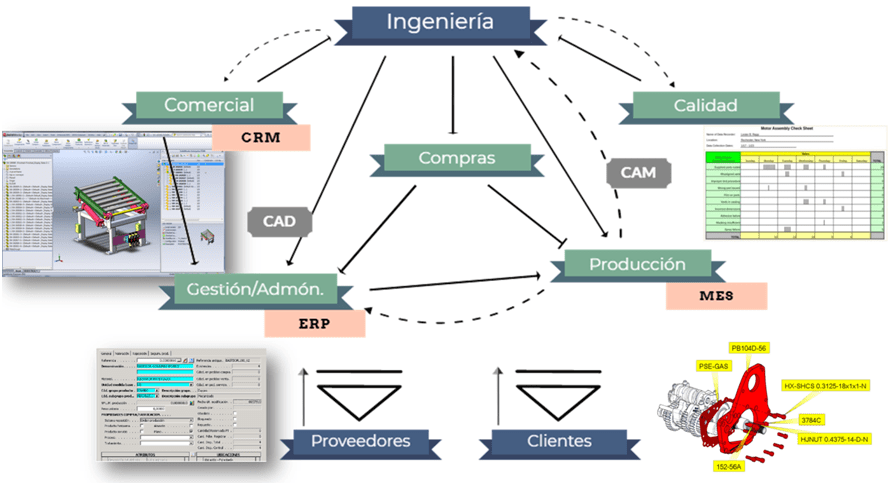
At Easyworks, we believe it’s essential to rethink the traditional product development process by fully leveraging today’s technologies and key innovations. So, what are these major shifts?
- We now have a much deeper understanding of market needs, driven by tools such as Big Data, marketing, and advanced analytics. This gives us greater insight to define, develop, and validate products more effectively.
- There is a growing demand for high levels of customization, with end customers increasingly involved in configuring their own products.
- We have access to a wide range of “as-a-service” tools, along with global collaboration and communication platforms such as online communities, forums, subcontracting platforms, sales channels, and training ecosystems. In addition, technologies like augmented, virtual, and mixed reality are becoming part of the development process.
- Just as manufacturing has evolved with the replacement of manual labor by robotics, engineering offices are moving toward automation of repetitive tasks, enabled by software. The goal is clear: free up engineers to focus on innovation and value-added work.
- Today, we also rely on powerful predictive assistance tools—“assistants for everything”—supporting tasks such as design for additive manufacturing, plastic injection, and advanced engineering calculations.
The idea that best summarizes digitalization for us is this:
the focus shifts to the WHAT (ideas and concepts), rather than the HOW (execution).
Muy interesante y fundamental, la verdad que las empresas tienen un gran trabajo a la hora de digitalizar los procesos para lograr adaptarse a los cambios del momento.